Some are Runner#
One of decentralized usage is: some of them is/are Runner. Therefore, in this usage case, it has 2 different roles in the cluster Runner and Backup Runner. Let’s explain the details of this usage and how to use it.
Infra#
Let’s demonstrate the infra of this usage case.
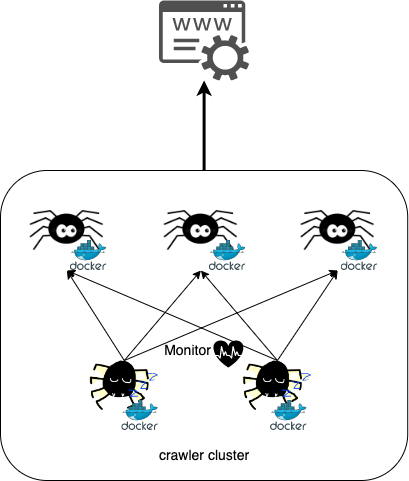
Assume each crawler instances run in different single container. It’s obvious that it has 3 Runner to run all tasks in cluster and it also has 2 Backup Runner to keep monitoring other 3 Runner and stand by for replacing it to run.
Therefore, the truly task runners are the 3 Runner instances, and the rest, the 2 Backup Runner crawlers won’t join the task running, they only stand by for handing over Runner crawler’s task if it’s dead to ensure the cluster could keep running without any problem.
How to use?#
Let’s demonstrate how to use SmoothCrawler-CLuster to implement for this usage scenario.
About ZookeeperCrawler, you need to pass arguments runner and backup to configure cluster.
from smoothcrawler_cluster import ZookeeperCrawler

zk_crawler = ZookeeperCrawler(runner=3,
                              backup=2,
                              name="crawler_<index>",
                              zk_hosts="localhost:2181")
In default, it would run election to decide to who is/are Runner in instantiate process. So it already be one specific role
when you do anything with the instance zk_crawler, e.g., start to run this crawler.
zk_crawler.run()
Prods and cons#
Advantages#
If the target HTTP server cannot load big amount of traffic or it has limitation of traffic, this usage could save more resource.
The responsibility of each role is pure. They only focus on one thing.
Disadvantages#
It needs to run election for choosing Runner so it also needs more time to run because of convergence for Runner.
Cluster cannot make all-out effort to run task.