Data Flow#
In SmoothCrawler-Cluster processing, it has complicated data flow with each others to transfer each one’s info about their running state, heartbeat state, etc, so let entire cluster could run finely without any problem.
This section would explain how the data flow works in SmoothCrawler-Cluster.
Data pipline with role#
It has different roles in SmoothCrawler-CLuster, so it also has different data flow with different roles. But before it to be an one specific role, it still transfer something info with each other’s or record something like its heartbeat info.
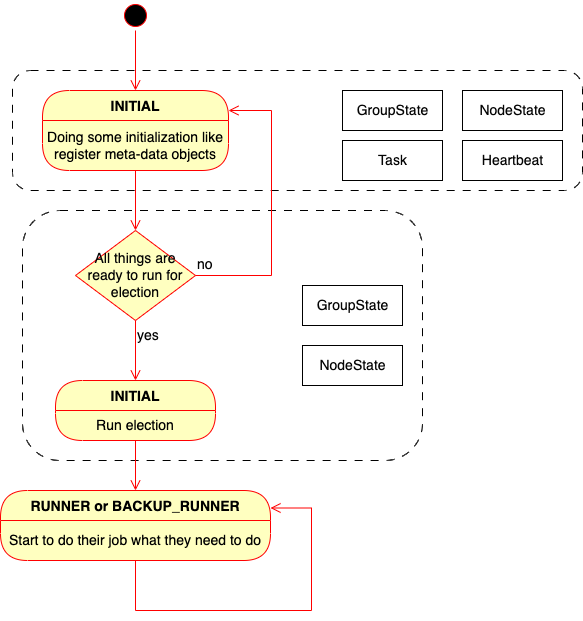
Below is the data flow to demonstrate what meta-data it would operate within a work flow:
Initial Processing#
First of all, it would register all the meta-data it needs. The registration processing would initial each one as empty meta-data objects with initial values from crawler if it has. And after it ensure to finish initialization, it would start to run election.
Operating meta-data:
GroupState
NodeState
Task
Heartbeat
Run election#
Before it start to run election, it would verify the meta-data GroupState value should be same as its expected, i.e., GroupState.total_crawler should be same as the sum of crawler’s parameters runner and backup. It would run the election after it has done verification.
The election would use the values from GroupState to do filtering process and make the decision of who is/are Runner. Each one would know their own role and update it in their meta-data NodeState.
Therefore, it runs as one specific role after it has done above all things.
Operating meta-data:
GroupState (if it is Runner):
current_crawler
current_runner
GroupState (if it is Back_Runner):
current_crawler
current_backup
standby_id
NodeState:
role
Data flow in different roles#
Runner#
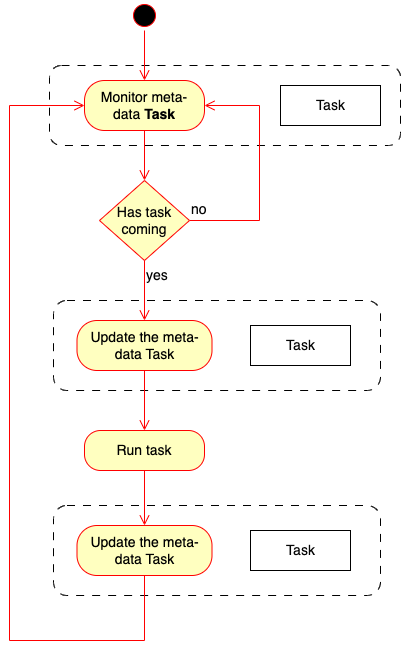
If it is Runner, its data flow is very simple. It only operates meta-data Task.
Monitor task#
In beginning, it would monitor the meta-data Task to check whether it has tasks or not. It only runs after-processing if it has task, nor it won’t do anything and keep monitoring.
Operating meta-data:
Task:
running_content
in_progressing_id
Before run task#
It updates the meta-data Task first before it runs each one task. If it is the first time to run this tasks, it updates attributes running_status and in_progressing_id; otherwise, it updates only one attribute in_progressing_id.
Operating meta-data:
Task:
in_progressing_id
running_status
After done task#
No matter what running result is, it updates the meta-data task again after it finishes one of tasks. It updates 2 attributes running_result and result_details.
Finally, it would reset the attributes Task.running_content and Task.in_progressing_id after it finish all tasks.
Operating meta-data:
Task:
running_content
in_progressing_id
running_status
running_result
result_detail
Back Runner#
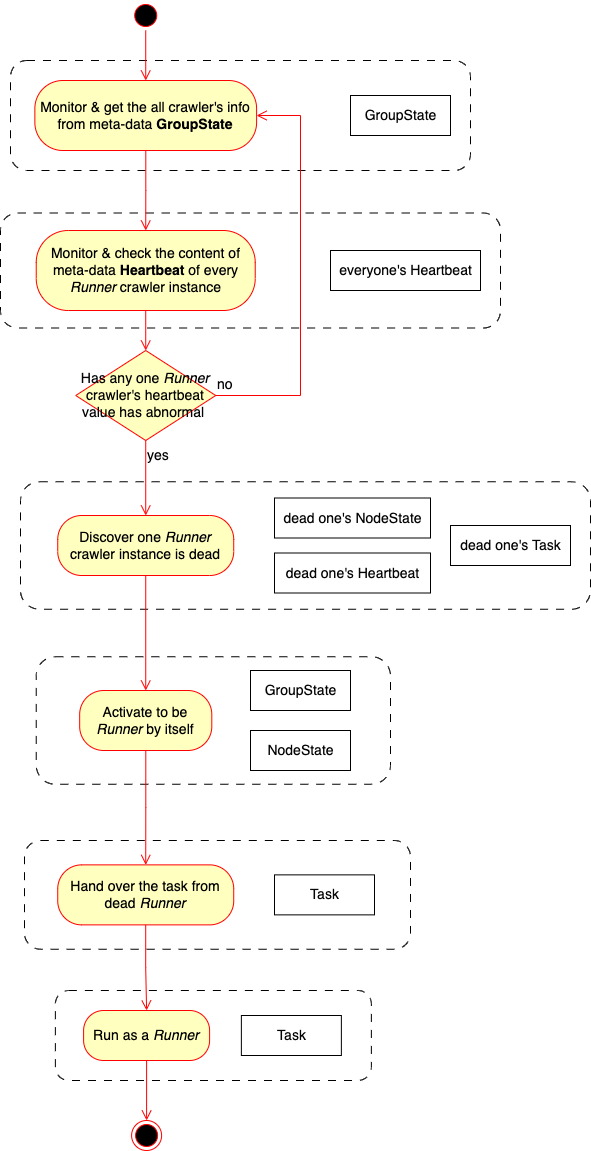
If it is Backup_Runner, its data flow is more complex than Runner. It operates every meta-data in this role’s process.
Verify everyone’s heartbeat#
In beginning, it gets all crawler’s name who is Runner be meta-data attribute GroupState.current_runner, and it would verify each one’s heartbeat info to judge whether they all are alive or not. If it find any problem, it would run after-processing, nor it won’t do anything and keep monitoring everyone’s heartbeat info.
Operating meta-data:
GroupState:
current_runner
Heartbeat:
heart_rhythm_time
time_format
update_timeout
heart_rhythm_timeout
Discover someone is dead#
If it discover any one of crawlers is dead, it updates the dead one’s meta-data NodeState and Heartbeat to mark it as dead. It would update NodeState.role as Dead_Runner and update Heartbeat.healthy_state, Heartbeat.task_state to be HeartState.ASYSTOLE and the dead one’s Task.running_status currently.
Operating meta-data:
NodeState:
role
Heartbeat:
healthy_state
task_state
Activate to be Runner#
In this process, it updates its own meta-data GroupState and NodeState to activate itself to be Runner.
Operating meta-data:
NodeState:
role
GroupState:
total_backup
current_crawler
current_runner
current_backup
fail_crawler
fail_runner
standby_id
Hand over the dead one’s task#
After it activates itself to be Runner, it checks the attribute Task.running_status of dead one and hands over it if the task has not finish yet. So it would copy mostly all Task to its own meta-data Task.
Operating meta-data:
Task (task’s running_state is TaskResult.PROCESSING):
entire Task object
Task (task’s running_state is TaskResult.NOTHING or TaskResult.ERROR):
in_progressing_id
running_result
result_detail
Run as Runner#
It starts to run as Runner from now on. So we could back to refer Runner.
Operating meta-data:
Task: